Canada's Minimum Wage After October 1: Who Got a Raise and Who Is Still Waiting
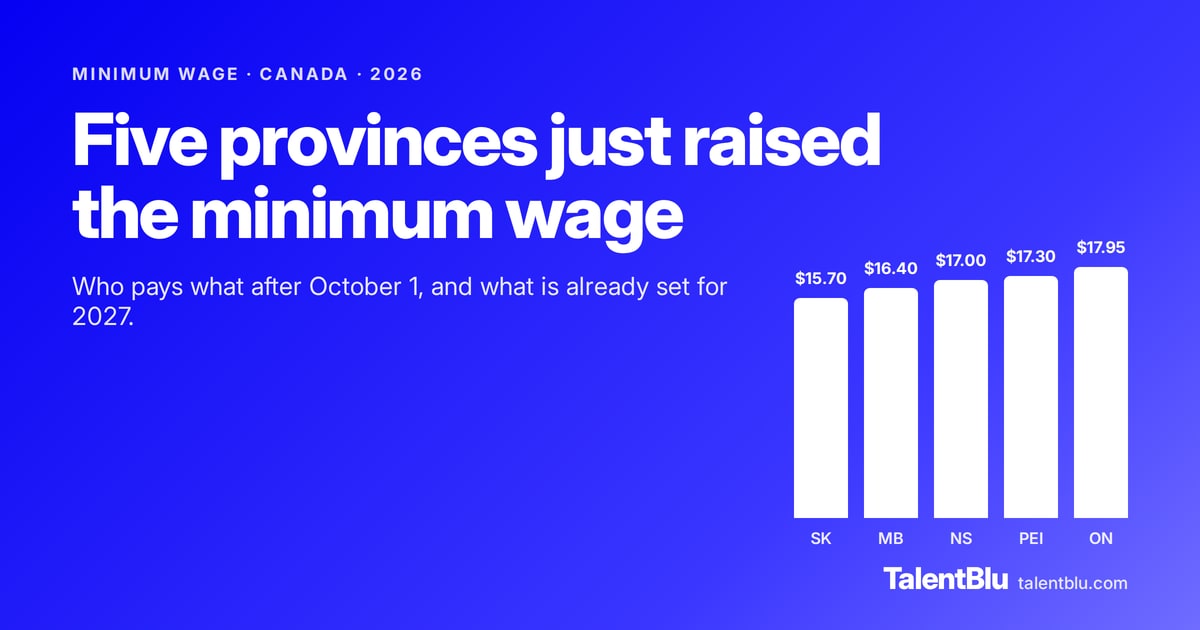
Five provinces raised their minimum wage on October 1, 2026. Here is every provincial rate today, what the raise is worth over a year, and what is already set for 2027.
On this page
On October 1, five provinces raised their minimum wage on the same morning: Ontario, Manitoba, Saskatchewan, Nova Scotia and Prince Edward Island. If you are paid by the hour in one of them, your first full paycheque at the new rate has probably already landed. Here is what changed, how each province compares now, and what is already on the calendar for 2027.
One thing before the numbers. Canada does not have a single minimum wage. Each province and territory sets its own, on its own date, and there is a separate federal rate for a small group of industries. That is why a cashier in Lloydminster can earn a different minimum depending on which side of the street the store is on.
Where every province stands today
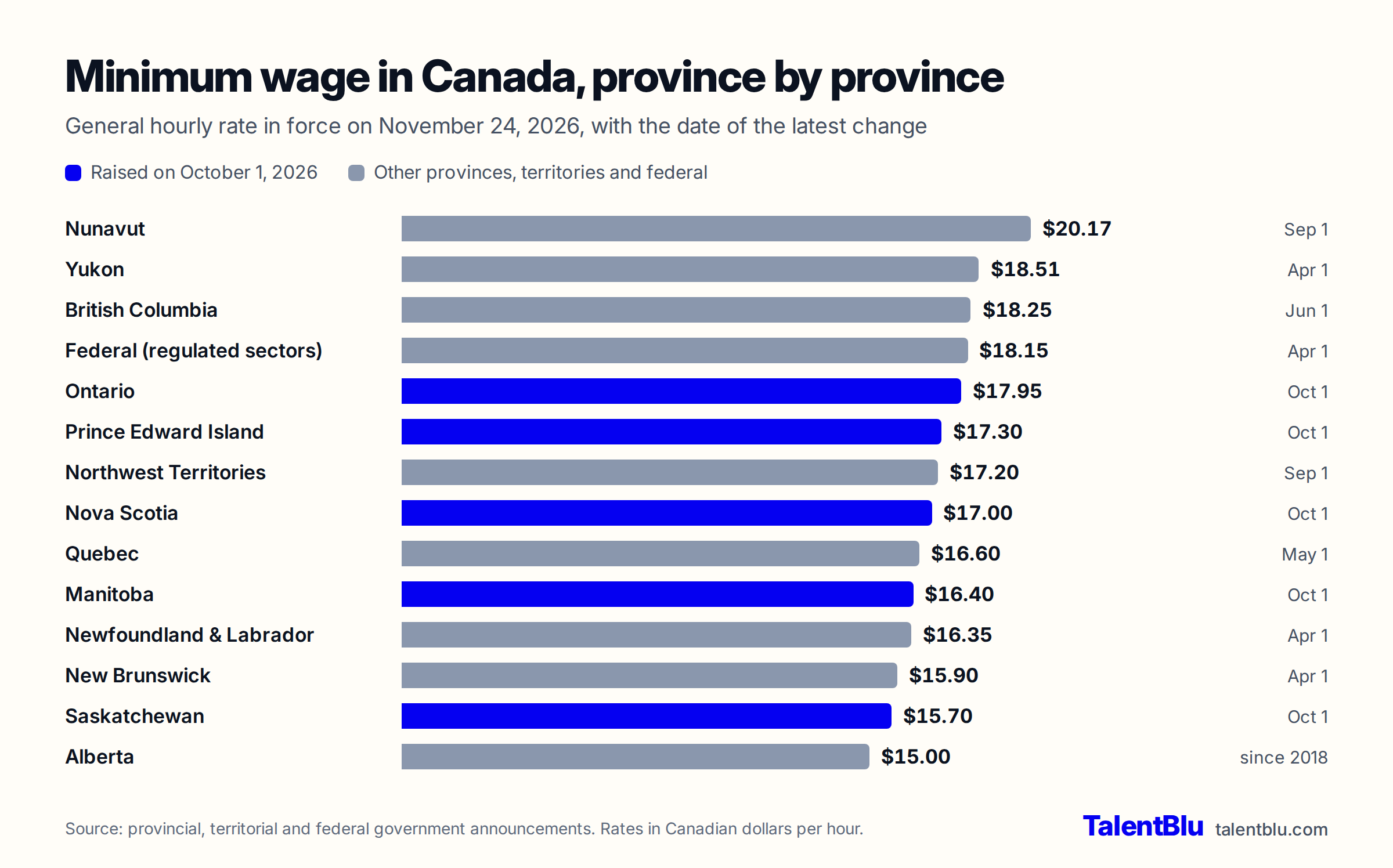
These are the general adult rates in force as of November 24, 2026, from highest to lowest.
| Province or territory | Hourly rate | In force since |
|---|---|---|
| Nunavut | $20.17 | September 1, 2026 |
| Yukon | $18.51 | April 1, 2026 |
| British Columbia | $18.25 | June 1, 2026 |
| Federal (regulated sectors) | $18.15 | April 1, 2026 |
| Ontario | $17.95 | October 1, 2026 |
| Prince Edward Island | $17.30 | October 1, 2026 |
| Northwest Territories | $17.20 | September 1, 2026 |
| Nova Scotia | $17.00 | October 1, 2026 |
| Quebec | $16.60 | May 1, 2026 |
| Manitoba | $16.40 | October 1, 2026 |
| Newfoundland and Labrador | $16.35 | April 1, 2026 |
| New Brunswick | $15.90 | April 1, 2026 |
| Saskatchewan | $15.70 | October 1, 2026 |
| Alberta | $15.00 | October 1, 2018 |
Nunavut is the only place above $20. That says more about the price of groceries in Iqaluit than about generosity. Among the provinces, British Columbia leads at $18.25 and Ontario is now 30 cents behind it.
What 35 cents an hour looks like on a paycheque
The October raises were small. None reached 50 cents. Ontario went from $17.60 to $17.95, and the province says about 700,000 workers are affected. Manitoba had the biggest step of the five, 40 cents, and Nova Scotia the smallest at 25.
Cents per hour are hard to picture, so we did the yearly math for someone working 40 hours a week all year.
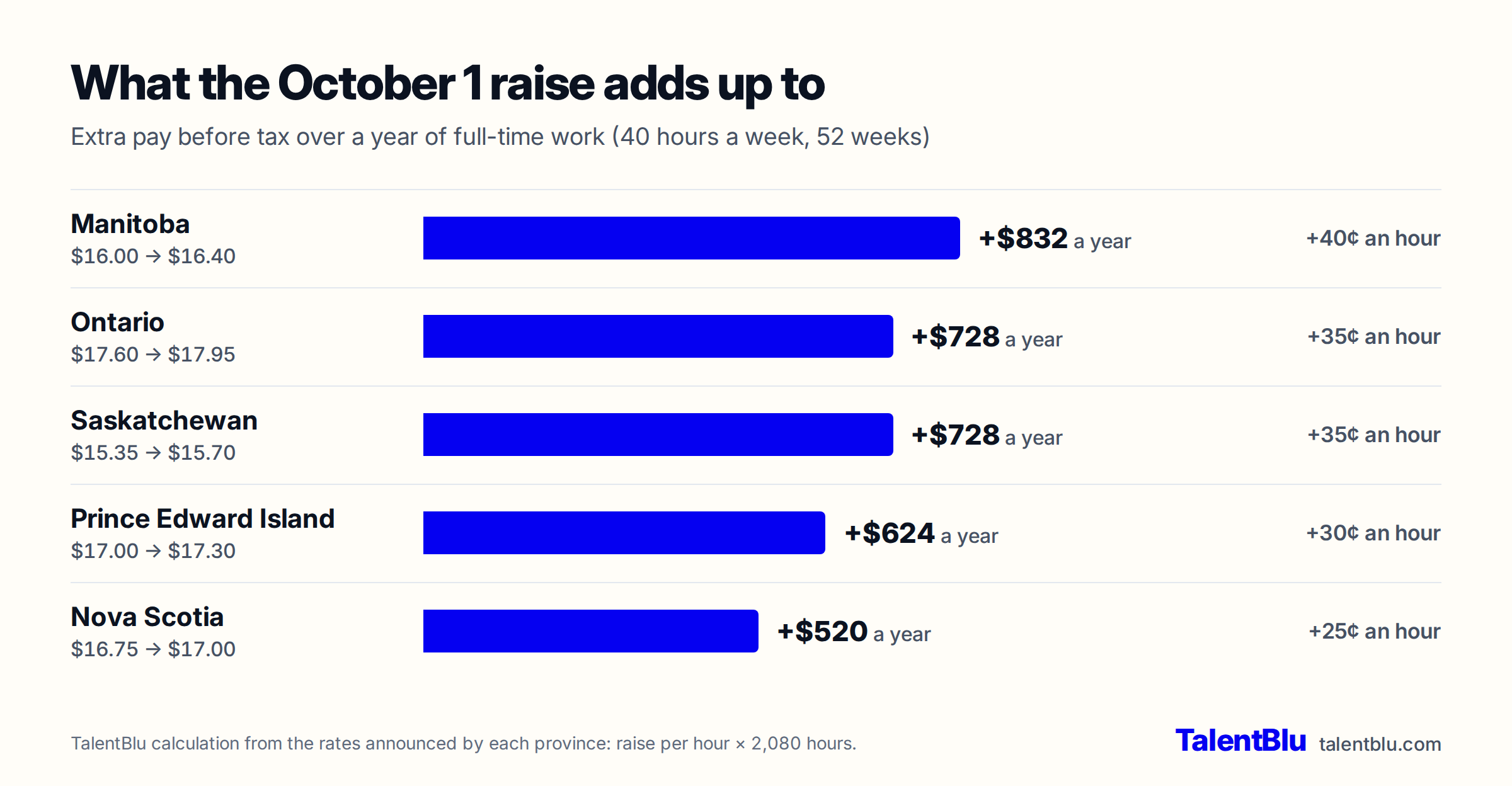
In Ontario that is $14 more a week before deductions, or $728 over the year. In Manitoba it is $832. Useful, but nobody is moving apartments on it. Most people on minimum wage also do not get 40 hours. At 25 hours a week, the Ontario raise is worth $8.75 a week.
Ontario has two lower-profile rates that moved the same day. The student minimum, for under-18s who work 28 hours a week or less during the school year, went from $16.60 to $16.90. The homeworker rate went from $19.35 to $19.70.
Not everyone moves in October
October 1 gets the headlines because Ontario is in it, but the raises are spread across the year.
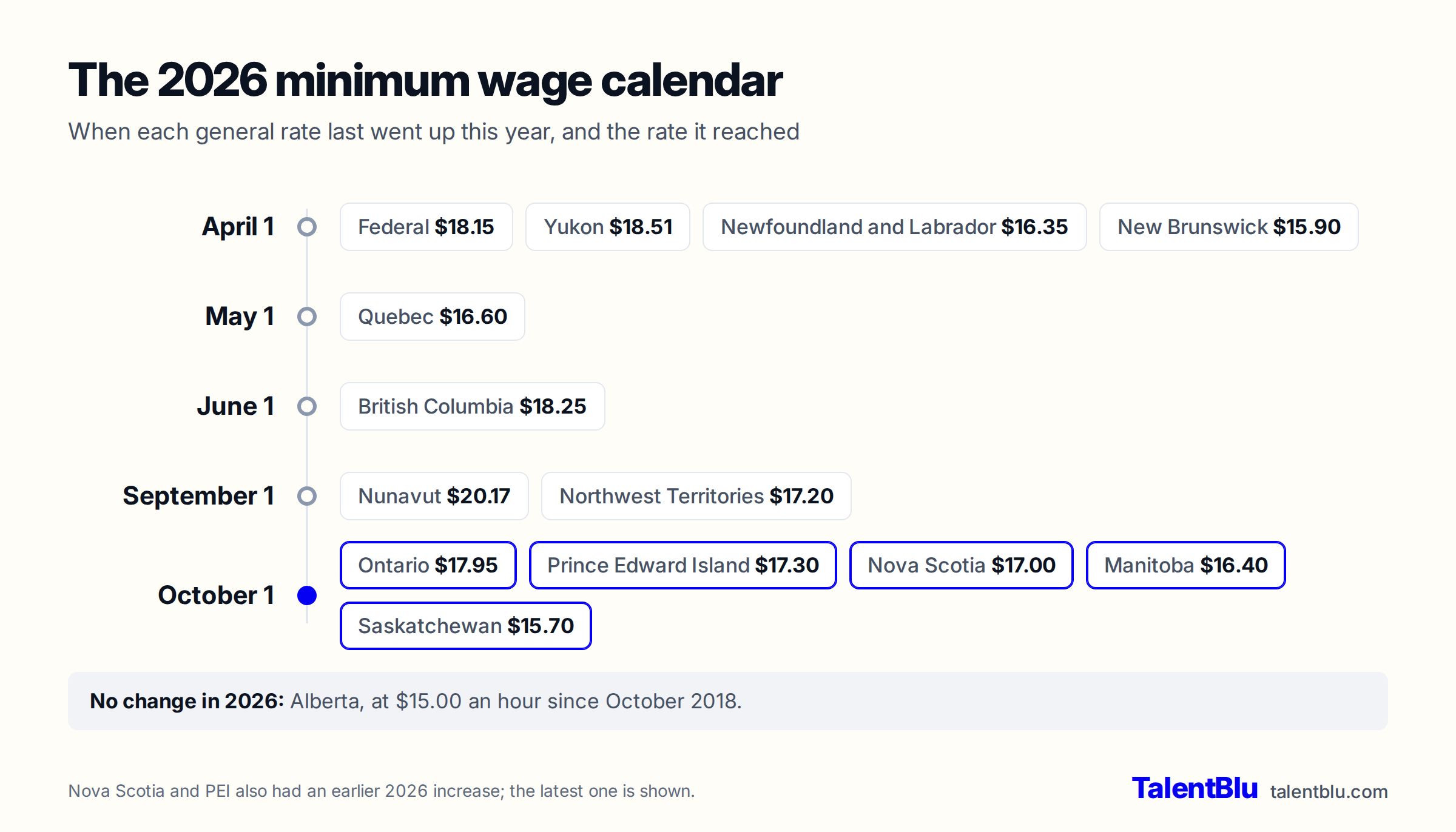
April 1 is the date for the federal rate, Yukon, New Brunswick and Newfoundland and Labrador. Quebec changes on May 1 and British Columbia on June 1. Nunavut and the Northwest Territories change theirs on September 1.
Nova Scotia and Prince Edward Island are the two that raise twice. Both had a first step earlier in 2026 and a second on October 1. PEI started the year at $16.50 and ends it at $17.30.
Most of these increases are no longer a political decision made each year. Ontario, British Columbia, New Brunswick, Newfoundland and Labrador, Yukon and the federal government tie their rate to inflation, so the raise follows the Consumer Price Index. Nova Scotia uses inflation plus one percentage point. That is why the numbers look odd: nobody chooses $18.51 on purpose.
Alberta, eight years at $15
Alberta is the exception on every chart in this article. Its minimum wage has been $15.00 since October 1, 2018. Back then it was the highest in Canada and the first province to reach $15. Today it is the lowest, 70 cents under Saskatchewan and $3.25 under British Columbia next door.
Over a full-time year, that gap with B.C. is $6,760 before tax. Alberta also keeps a $13 rate for students under 18. There is no increase scheduled, and the province has no formula that would trigger one automatically.
What is already set for 2027
Only one 2027 number is confirmed so far. Prince Edward Island goes to $17.60 on April 1, 2027.
The rest is predictable in timing but not yet in amount. The federal rate, New Brunswick, Newfoundland and Labrador and Yukon adjust every April 1 using inflation figures, and their 2027 rates had not been published when we checked. Ontario usually announces its October rate around April 1, six months ahead. With inflation running near 2%, expect raises in the 30 to 40 cent range again, not a jump.
If you are paid minimum wage, check three things
- Your pay stub. Hours worked on or after the effective date must be paid at the new rate, even if the pay period started before it. If your October stubs still show the old number, ask payroll. Mistakes in the changeover week are common and are usually fixed quickly.
- Which rate applies to you. If you work for a bank, an airline, a telecom company or an interprovincial trucking firm, you are federally regulated. You get the federal $18.15 or your province's rate, whichever is higher.
- What other employers pay. The minimum is a floor. Plenty of warehouse, retail and food service postings start a dollar or two above it, especially for evening and weekend shifts.
Jobs open in Canada right now
- Senior CX Platform EngineerGitLab · Canada
- Senior Software Developer, Agentic AI - CanadaClover Health · Canada
- Regional Sales Director, CanadaGitLab · Canada
- Senior Software Engineer II - Agentic IntelligenceHoneycomb.io · Canada
- Senior Software Developer - CanadaClover Health · Canada
Sources
Rates were checked on November 24, 2026 against provincial and federal announcements and these summaries:
- Littler: Canada minimum wage increases effective October 1, 2026
- Canadian HR Reporter: Which 5 provinces are increasing minimum wage rates today?
- Littler: Canada minimum wage increases in 2026
- Moving2Canada: provinces and territories increasing minimum wage this fall
The yearly figures are our own calculation: the raise per hour multiplied by 2,080 hours.
Published on November 24, 2026 · 5 min read